
60-Year Recertification in South Florida: What Condo Boards Need to Know Before Signing Construction Contracts
Blog post description.
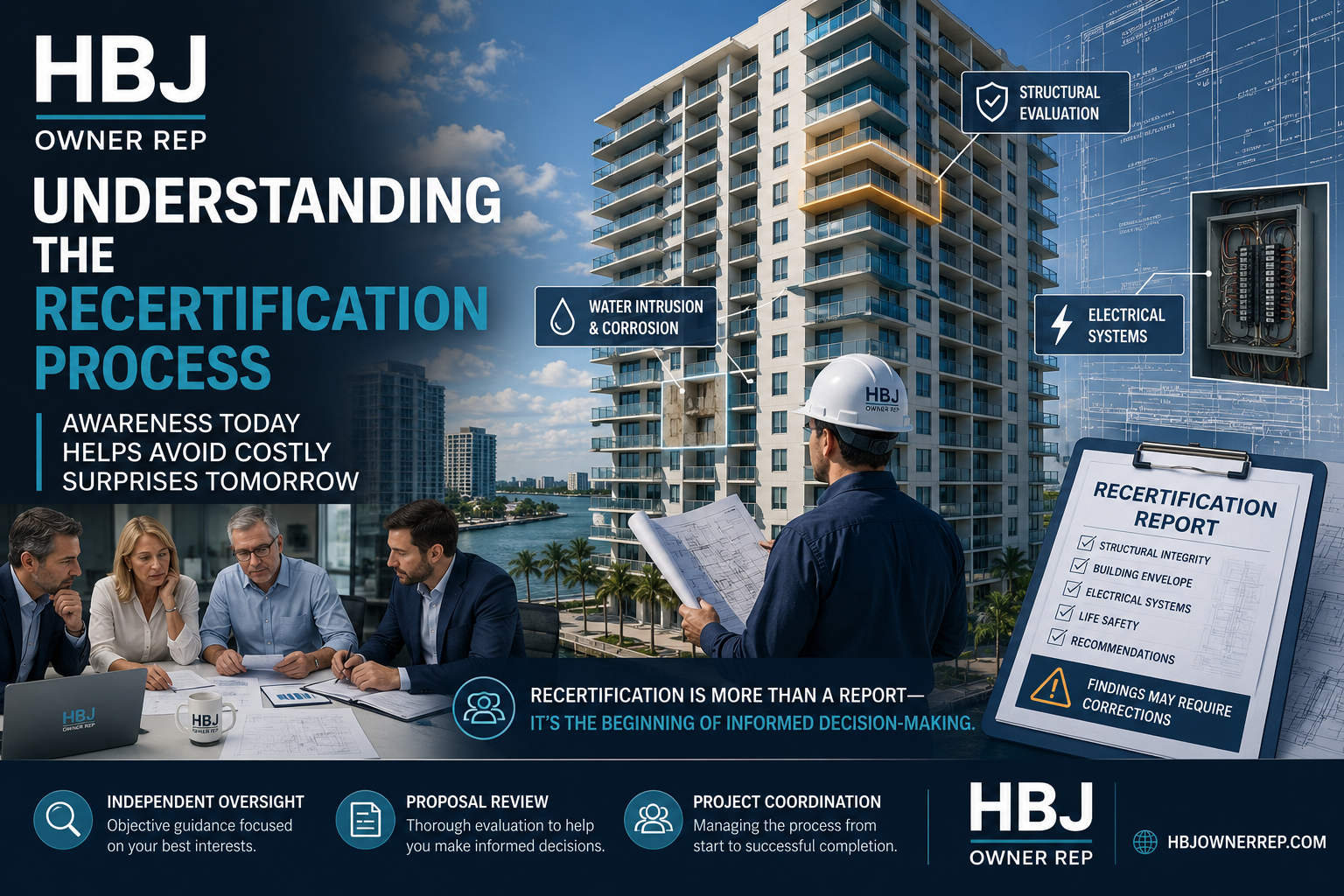
30,40,50,60-Year Recertification in South Florida: What Condo Boards Need to Know Before Signing Construction Contracts
For many condominium associations throughout Broward and Miami-Dade Counties, the 60-Year Recertification process represents one of the largest financial and operational challenges a community will face.
What often begins as an engineering inspection can quickly evolve into a complex construction project involving concrete restoration, waterproofing, electrical upgrades, structural repairs, roofing, balconies, elevators, and other life-safety improvements.
While most boards understand the importance of hiring qualified engineers and contractors, many underestimate the risks that arise once repair recommendations turn into construction contracts.
The reality is simple: the difference between a successful recertification project and a costly one often comes down to oversight, scope clarity, and contract administration.
The Hidden Challenge of Recertification Projects
Most board members are volunteers.
They may be highly successful professionals in their respective fields, but few have experience managing six-figure or seven-figure construction projects.
As a result, boards frequently find themselves reviewing proposals filled with technical language, exclusions, allowances, contingencies, and assumptions that are difficult to evaluate.
Unfortunately, unclear proposals can create significant exposure for associations later in the project.
A low bid may not always be the lowest final cost.
Likewise, a proposal that appears complete may contain exclusions that ultimately become change orders.
This is where many communities encounter unexpected budget increases.
Red Flag #1: Vague Scope Language
One of the most common issues found in construction proposals is scope language that lacks detail.
Phrases such as:
“Repair as needed”
“Field verify conditions”
“Additional work may be required”
“Extent to be determined”
“Pricing excludes unforeseen conditions”
may appear harmless at first glance.
However, these statements can create uncertainty regarding what is actually included in the contract amount.
When scopes are not clearly defined, disputes often arise regarding responsibility, pricing, and expectations.
Boards should fully understand exactly what is included—and equally important—what is excluded.
Red Flag #2: Unlimited Change Order Exposure
Every construction project may encounter unforeseen conditions.
The question is not whether surprises occur.
The question is how those surprises are managed.
Without proper controls, associations can find themselves approving change orders throughout the project with little ability to forecast final costs.
Many boards focus heavily on the initial contract amount but spend less time evaluating how additional work will be authorized.
A clear process for reviewing, documenting, and approving changes is critical to maintaining budget control.
Red Flag #3: Lack of Not-To-Exceed (NTE) Protections
One term frequently discussed in construction oversight is “Not-To-Exceed” pricing, commonly referred to as NTE.
While every project is unique, boards should understand how cost limitations, allowances, and contingency budgets interact with the overall contract.
Without clearly defined financial parameters, associations may have difficulty determining the maximum potential exposure associated with certain portions of work.
Understanding where costs are fixed and where costs remain variable can significantly impact budgeting and reserve planning.
Red Flag #4: Incomplete Bid Comparisons
Many boards receive multiple proposals and assume they are comparing identical scopes.
In reality, that is not always the case.
Contractor A may include demolition.
Contractor B may exclude it.
Contractor C may include permits.
Contractor D may treat permits as an owner responsibility.
The result is that boards may unknowingly compare apples to oranges.
The lowest number on paper does not necessarily represent the lowest overall project cost.
Before selecting a contractor, boards should ensure proposals are being evaluated consistently and completely.
Red Flag #5: Payment Applications Without Verification
Construction projects often involve progress payments throughout the duration of the work.
Boards naturally want projects to move forward efficiently.
However, approving payments without confirming completed work can create unnecessary risk.
Questions should always exist regarding:
Work completed versus work billed
Stored materials
Schedule progress
Change order status
Remaining contract balance
Proper verification procedures can help ensure payments remain aligned with actual project progress.
Red Flag #6: Communication Gaps Between Professionals
Most recertification projects involve multiple parties.
These may include:
Engineers
Contractors
Attorneys
Property Managers
Board Members
Vendors
Municipal Officials
Each party serves an important function.
However, each party also operates from a different perspective.
Miscommunication between stakeholders can lead to delays, confusion, duplicated efforts, and unnecessary expenses.
Successful projects often depend on maintaining alignment between all parties throughout the construction process.
Why Independent Oversight Matters
The purpose of independent oversight is not to replace engineers, contractors, attorneys, or property managers.
Each professional plays a critical role.
Instead, oversight focuses on helping boards understand project information, identify potential risks, maintain organization, and improve visibility throughout the construction process.
When large contracts, significant special assessments, and resident expectations are involved, even small misunderstandings can become expensive.
The most successful associations are often those that take a proactive approach before contracts are signed—not after problems arise.
Final Thoughts
The 60-Year Recertification process is about more than passing an inspection.
It is about protecting the long-term value, safety, and financial stability of the community.
Before committing to major construction contracts, boards should ensure they fully understand the scope, pricing structure, exclusions, potential change order exposure, and overall project responsibilities.
The questions asked before a contract is signed often determine the outcome of the project long after construction begins.
About HBJ Owner Rep
HBJ Owner Rep provides independent project oversight and owner-focused support for condominium associations, self-managed communities, investors, and property owners navigating complex capital improvement projects throughout South Florida.
Disclaimer: HBJ Owner Rep is not a licensed engineering firm, general contractor, or law firm and does not provide engineering, construction, or legal advice. Associations should consult qualified licensed professionals regarding project-specific decisions.
A 60-Year Recertification project is more than an engineering report—it’s often one of the largest financial decisions a condominium association will ever make.
From vague scopes and contractor exclusions to change order exposure and unclear pricing structures, small details in construction proposals can lead to significant costs later. Understanding what to look for before contracts are signed can help boards make more informed decisions and avoid unnecessary surprises.
In this article, we discuss common red flags associated with recertification projects, why proposal clarification matters, and how independent oversight can help associations maintain visibility throughout the construction process.
Before your board commits to a major capital improvement project, make sure you understand what questions should be asked first.
HBJ Owner Rep provides independent oversight and owner-focused support for condominium associations navigating complex construction and recertification projects throughout South Florida.
HBJ Owner Rep helps condominium associations, self-managed communities, and property owners review construction proposals, coordinate project information, and provide independent oversight during capital improvement projects.
Disclaimer: HBJ Owner Rep is not a licensed engineering firm and does not provide engineering or legal advice. Associations should consult qualified licensed professionals regarding plumbing design, engineering evaluations, and legal matters.